
Opportunity Zone Designation
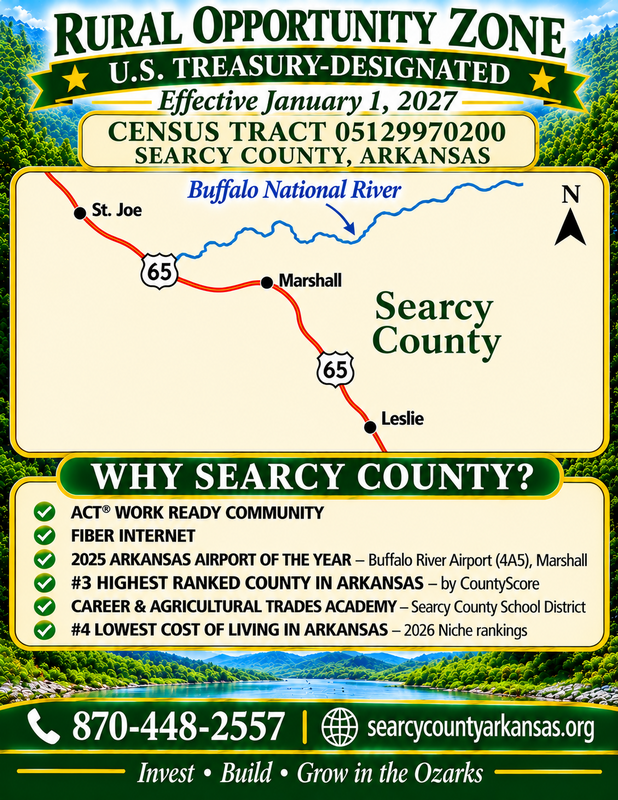
MARSHALL, Ar -- The U.S. Department of the Treasury and the Internal Revenue Service (IRS) on 5 November announced the Qualified Opportunity Zone (QOZ) designations for all 50 states, territories, and the District of Columbia. The Marshall Census Tract in Searcy County was named after being nominated by Governor Sarah Huckabee Sanders. Marshall Mayor Kevin Elliot said, “An Opportunity Zone is more than a designated area—it is an opportunity to strengthen our community, attract new businesses, create jobs, and encourage investments that will benefit our citizens for generations to come.”
Executive Director Darryl Treat of the Greater Searcy County Chamber of Commerce, said, “Marshall is eagerly looking for new investment to take advantage of this rural Opportunity Zone designation! Historically, Searcy County has been at or near the very bottom of the state in average weekly wages and food security, and this is an opportunity to bring in new jobs that pay good wages and new jobs that produce a positive multiplier effect throughout the local economy.” “In today’s highly competitive world, the communities that have decent jobs stand a much better chance of survival into the future than the communities that don’t,” Treat expressed.
The Marshall Census Tract has a 23.5% poverty rate. Only up to one-quarter of Arkansas’ eligible low-income census tracts could be nominated for the OZ designation. “In the past several years we had multiple potential investors ask if we were an opportunity zone, which I had to answer No,” Treat explained. “Now we can say Yes!”
“In 2018, Searcy County was left out of an opportunity zone designation despite the chamber of commerce applying for both the Marshall and Leslie Census Tracts,” Treat continued. This time around, the Leslie tract did not meet the qualifications to be considered. Opportunity Zones can also be used in conjunction with the Community Development Block Grant (CDBG) program.
According to the Internal Revenue Service (IRS), Opportunity Zones tax incentive is an economic development tool that allows people to invest in distressed areas. This incentive's purpose is to spur economic development and job creation in distressed communities by providing tax benefits to investors.
Searcy County Judge Tony Horton said, "This Opportunity Zone designation will have a positive impact on our community. Hopefully this opportunity will allow our younger generation to live in their community and not have to move away due to the inability to survive and thrive at home."
According to the IRS, recent changes to Qualified Opportunity Zones enhance tax incentives for taxpayers who invest in rural areas. Investments in QOZs ultimately help improve economic growth and job creation in these communities. Under the One, Big, Beautiful Bill, the substantial improvement threshold for improvements to property located in a QOZ that is comprised entirely of a rural area, has been modified. As of July 4, 2025, the substantial improvement threshold for required additions to the basis for property located in these QOZs was reduced from 100 percent to 50 percent.
Bob King, President of the Buffalo River Community Development Corporation said, “This opportunity zone designation gives the Marshall area a chance to attract the kind of investment that is vital to keep a rural community thriving into the future!” “We know from our own history that jobs, industries, and infrastructure do not last forever, King continued. He said, “We had ancestors here that were economically adaptable, enterprising, and innovative, and the opportunity zone gives us a chance to continue their legacy.”
Under President Trump’s Working Families Tax Cuts, the Opportunity Zone tax incentive was permanently renewed, enhanced incentives for investment in eligible rural communities were added, and a process was established for redesignating zones every ten years. The new QOZ designations will become effective on January 1, 2027, and retain this designation for ten years.
“Under President Trump’s leadership, the Working Families Tax Cuts permanently renewed and strengthened Opportunity Zones, giving investors, entrepreneurs, and local leaders the long-term certainty they need to commit capital to communities that have been overlooked for too long,” said Treasury Secretary Scott Bessent. “Today’s announcement of the new designations will help direct private investment to these communities, expand economic opportunity, support job creation, and unlock long-term growth in these communities across the country.”
According to the Center on Rural Innovation (CORI), “For rural entrepreneurs, the value is simple: being located in an Opportunity Zone can make a business more visible to outside investors. Qualified Rural Opportunity Funds have the flexibility to invest in equipment, property, and businesses, not just real estate. That matters for rural businesses, where growth often depends on scaling operations rather than financing buildings.”
###